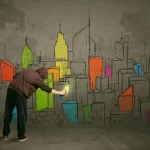
Stencil art is a kind of art that captures you. You are going to work, half-thinking about a cup of coffee, and all of a sudden you can see a wall with a crisp picture, sharp lines, strong message, and no hesitation. It is the magic: stencil work is the kind of work that is …

Stencil art is a kind of art that captures you. You are going to work, half-thinking about a cup of coffee, and all of a sudden you can see a wall with a crisp picture, sharp lines, strong message, and no hesitation. It is the magic: stencil work is the kind of work that is instantly created and, at the same time, created on the basis of planning, patience, and several clever tricks.
What Are Stencil Art Methods?
Stencil art Stencil art is a technique in which an artist uses a sheet of paper (the stencil) to cut out a pattern onto which he or she adds paint or ink by filling in the cut out areas. Such popular methods as single-layer stencils, multi-layer color stencils, negative space designs, photorealistic stencil layering with registration marks to be aligned are used.
An Overview of the history of street art: The rise of repetition or revolution
Stencil art did not commence as street art. Signage, textiles, and advertising Stencils have been in use since ancient times due to their efficiency and uniformity.
However, modern stencil graffiti discovered its voice in the late 20th century cities. Artists understood that stencils could not be simply the tool of shortcut, but the language. A stencil would be able to be rolled out in a few minutes, reproduced throughout the neighborhoods, and interpreted immediately.
When you have ever looked at the work of Blek le Rat (commonly referred to as an early user of stencils graffiti in Paris) or the black and white, universally familiar, imagery of Banksy, you have seen why stencils are a perfect fit in the street: quick, graphic, and scannable up. Obey is the style created by Shepard Fairey which is based on the idea of graphic repetition and demonstrates how a simple image can develop into a cultural echo in case it is repeated accurately.
The combination of crafting and message is the power of stencil street art. It is graphic design that is encountering the public space with some defiance in the margins.
The Core Stencil Art Methods
1) Uni-Stencils: Clean, Fast, Iconic.
It is the traditional one; stencil, one color, solid silhouette.
-
Good On: logos, symbols, large portraits, plain text.
-
Pro tip: Focus on contrast. When your stencil design can be read at 10-15 feet at a distance, then it is time to put it on a wall, a poster, or a canvas.
Single-layer work is where most artists become in love with the medium- since it takes a few minutes to have a finished work, and still appear professional.
2) Multistage Stencils: The Printing Style to Street Style
The multi level stenciling is where one begins to believe in controlled magic. You cut distinct layers of shadows, mid-tones, highlights and various colors. You do it in turn then you paint them.
-
Best in: portraits, complicated illustrations, murals, color realism.
-
The key skill: This is the point of registration marks – little cut forms (triangles, crosses etc.) that can assist you in aligning every layer uniformly. This will in life spare you the trauma of having a final color that is positioned 3 millimeters out of place.
3) Negative Space & Bridges: Developing the Image
Stencil artists think like constructors and think like architects. You can not chop floating islands off-balance. This is the reason why bridges (thin connecting strips) are important, particularly in such letters as O, A, and R.
Negative space designs adopt the cut-out spaces as the primary subject. It is a clever way of daring legibility and it can be good on rough surfaces such as brick or stucco where minute details can be lost.
4) Photorel Art Stencil Layering: Photo to Street
Stencil art Photoreal Photoreal, or real Photoreal is constructed of a reference photo converted to value layers (light to dark). A digital workflow (plan-before-doing the hands-on craft) may be used by artists to plot out the cuts.
-
Reality test: This is a time-weighted method. However the reward is massive- when you maintain edges and values straight.
To achieve a realistic look of photography and yet retain your sanity, add 3 layers, not 10. Learn how to master first then complexity second.
Stencil Work Tools That Are Easier and Cleaner
You do not need a recording studio with all the equipment. But you must have a few sound basics.
Stencil Materials
-
Sheets are available in mylar (durable, flexible, easy to reuse).
-
Cardstock (not expensive, can be used to take rapid tests, not durable)
-
Acetate (transparent and of use in positioning, may be greasy)
Cutting Tools
There can be no compromise with a sharp craft knife and extra blades. Sharp blades lead to tearings, serrations, and pains on the hands.
A self cutting mat is used to cover your table to prevent cuts and make them even. Most artists also hold on to masking tapes or spray adhesives to stop the paint bleeding.
Paint & Application
-
Aerosols spray paint: speedy street quality.
-
Acrylic + sponge /roller: preferable inside, less controlled.
-
Markers: excellent where finer touch-ups and inning up of lines are required.
When you have ever noticed fuzzy edges, that is normally the paint bleed- usually through spraying too near to the surface or too much, or by not holding the stencil against the surface.
Basic Safety Tips: The Part that the majority of people miss
Stencil art may be surprisingly brutal to your flesh in case you disregard caution particularly with aerosols and blades.
Respiratory Protection and Ventilation
A large number of spray paints emit volatile organic compounds (VOCs) and tiny particles. Sucking them in a few times again and again is not an aura pro dieta de un artista es tough, it is a lung hazard.
When you want to spray, wear a well-ventilated space with a properly fitted respirator that covers fumes of paint (organic vapour), particulates and so forth. Outdoors are best. Headaches and irritation begin quickly indoors in cases where there is no airflow.
Hand and Eye Safety
Making stencils requires a lot of striking. Set yourself on a firm surface, make cuts outside of your body and rest.
When doing a lot of cutting, think of cut resistant gloves on the non cutting hand. Furthermore, eye protection is useful in scraping paint, flicking splatter, or in pressure work.
Surface Safety and Ethics
Illegal art is part of the street art history, but the most successful route in the long term is permission-based painting: legal walls, community, boards/canvases, or even commissioned murals. It protects you, respects neighborhoods and leaves your art up exempt from buffing overnight.
A Simple Workflow You Can Trust
The following is one of the useful tricks applied by numerous stencil artists:
-
Draw a design that has a high level of contrast.
-
Choose: single-layered or multi-layered.
-
Transfer the design to your stencil material by means of print and tape.
-
This is cut sharp, and the blades are frequently changed.
-
Add bridges where needed.
-
Test thru paper or cardboard.
-
Tape the stencil (tape/adhesive) and then coat it lightly.
-
Raise up and smooth the edges then record your findings.
That first test step is tedious, yet it is what makes the difference between muffed luck and skill that can be involved.
Why Stencil Art Still Wins in 2025
Stencil art suits the current lifestyle: rapid images, direct messages, repostable, and replicable design. It is also a cross-over—street and studio, protest and portrait, graphic design and fine art.
When you take care of your process, making smart strokes, safe spraying, you will not simply have a good-looking piece of work. It’ll look intentional. And recall it is what people do.
FAQs
1) Which are the least demanding stencil art techniques of beginners?
The simplest type of stencils are single-layers since you only concentrate on a single clean silhouette and a single color. Begin with massive shapes, basic letters or high contrast icons. Practice with cardstock and use mylar. Light sprays cut the edge of the paint and eliminate the bleed.
2) How do I prevent spurtage of spray paint under a stencil?
The presence of bleeding tends to be caused by heavy paint and loose contact. Stick the stencil and spray in small layers in a distance and do not flood the edges. On smooth surfaces spray adhesive can be used. In addition, use a flat surface of your stencil material and change distorted sheets to ensure a tight contact.
3) Is stencil street art safe and what protective equipment is of the most importance?
Stencil art is harmless provided that fumes and blades are taken seriously. VCs, as well as fine particles, can be found in the air, which is why ventilation and a respirator of the required type are essential. With a cutting mat, sharp blades and make sure you cut away the body. Protective gloves and eye protection are added.
Be the first to read my stories
Get Inspired by the World of Interior Design